

2026.10.14
Announcement of the Doctoral Program in Humanics Briefing session
2026.09.18
【Media Coverage】Japan Science and Technology Agency (JST) – Science Portal
2026.09.15
Notice of Partial Revision to the Application Guidelines for Doctoral Program in Humanics
2026.09.10
Application Guidelines for Doctoral Program in Humanics Now Available
2026.08.31
Application Guidelines for G-SIGMA Now Available
2026.06.29
Announcement: G-SIGMA Briefing Session on July 28
2026.05.01
Announcement of the Outline of Admissions for AY2027
We seek individuals who are committed to contributing to the future of humanity by identifying and addressing challenges that can drive paradigm shifts in the field of Humanics, which integrates medicine and human biology, and the physical sciences, engineering, information science, and materials science. Such individuals are expected to possess foundational knowledge in one of the following areas and a strong interest in interdisciplinary research across these fields:
Students who complete this program will become outstanding leaders with the bi-disciplinary expertise to incorporate the latest knowledge and technologies in medicine and human biology, and the physical sciences, engineering, information science, and materials science, communicate using the languages of both fields, conceive new paradigms through a deep understanding of these disciplines, and integrate them in order to realize such paradigms by utilizing cutting-edge technologies.
These Humanics leaders will possess rich creativity to generate integrated knowledge across disciplines through interactions between different fields, as well as advanced skills that enable them to play active roles in industry and the international community, thereby responding to societal and academic challenges.
Doctor of Philosophy
The curriculum is designed to cultivate the following competencies: a firm commitment to probing the essence of unknown problems; bi-disciplinary expertise spanning medicine and human biology, and the physical sciences, engineering, information science, and materials science; fundamental research skills in Humanics and an understanding of global trends in this field; the ability to independently formulate paradigm-shifting research questions; and the capacity to address these challenges with integrity and sincerity.
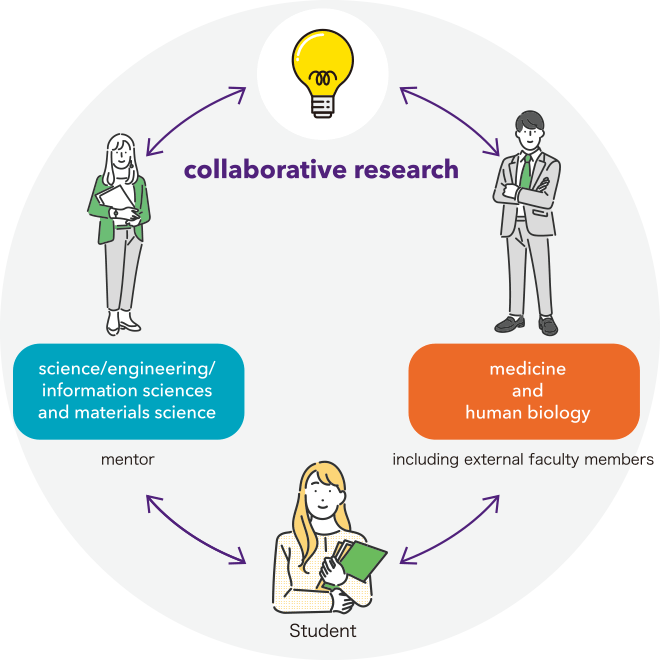
Humanics Research: Doctoral research based on collaborative studies that integrate two fields—medicine and human biology, and the physical sciences, engineering, information science, and materials science.
Examples include:
Sleep Medical Science
×
Next-Generation Mobility Technology
= Development of driver alertness and cognitive function monitoring technologies using automotive IoT systems
Spine and Spinal Cord Surgery
×
Cybernics
= Application of the wearable cyborg HAL to central nervous system spinal disorders and gait analysis by disease type
Sleep Neuroscience
×
MMRI Medical Physics
= Elucidation of functional networks during sleep in mice through the development of novel fMRI measurement methods
Enrollment Period
April and October
Admission Information
For details, please refer to the Application Guidelines on the website below.
University of Tsukuba Graduate AdmissionsFor information on student support services available at the University of Tsukuba, please see the G-SIGMA website below.
https://g-sigma.edu.tsukuba.ac.jp/en/#support
Additionally, the program is currently considering its own support measures to enable students to focus on their education and research.
For information as of April 1, 2026, please refer to the website below.
https://www.phd-humanics.tsukuba.ac.jp/en/support/
Email hxp-sigma@un.tsukuba.ac.jp
Interdisciplinary Education, Convergent Research, Medicine, Sleep Medicine, Human Biology, Neuroscience, Engineering, Information Science and Engineering, Materials Science, Cybernics, MDA, and Artificial Intelligence