


2026.10.20
Publication of the “Information and Instructions for Examinees” for the October 2026 Entrance Examination
2026.10.14
Announcement of the Doctoral Program in Humanics Briefing session
2026.09.18
【Media Coverage】Japan Science and Technology Agency (JST) – Science Portal
2026.09.15
Notice of Partial Revision to the Application Guidelines for Doctoral Program in Humanics
2026.09.10
Application Guidelines for Doctoral Program in Humanics Now Available
2026.08.31
Application Guidelines for G-SIGMA Now Available
2026.06.29
Announcement: G-SIGMA Briefing Session on July 28
The Graduate School of Integrative and Global Multidisciplinary Arena (G-SIGMA) addresses global issues that cannot be solved by a single academic discipline, advancing the integration of knowledge across disciplinary boundaries and its implementation in society.
◆Interdisciplinarity:
Education and research system across the disciplines of life sciences, information, law, economics, environment, and engineering
◆Internationality:
Partnership with 13 universities worldwide, multi-mentor system with international researchers
◆Practicality:
Implement research outcomes in society and create new value
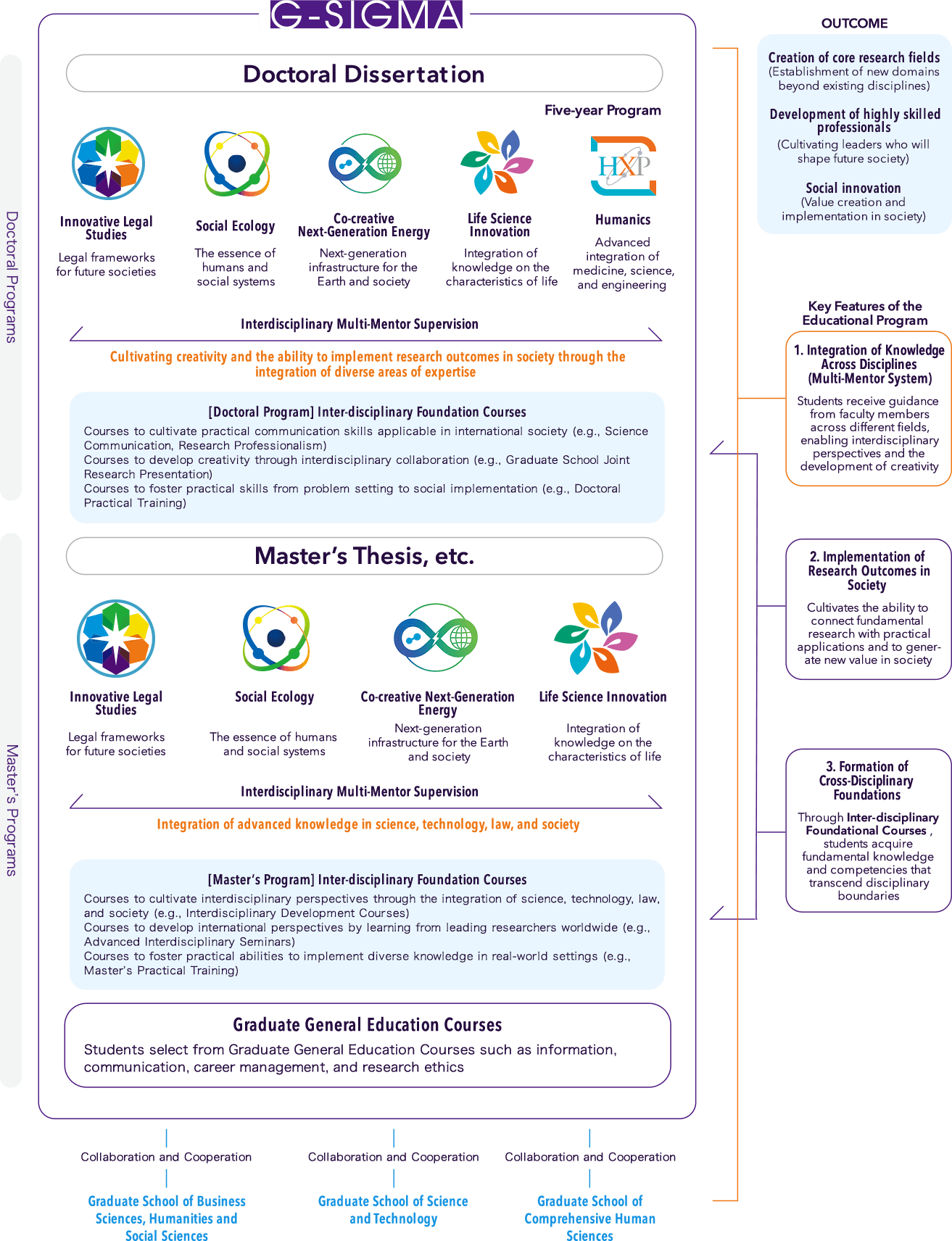
G-SIGMA is a new graduate school at the University of Tsukuba, consisting of the following five master's and doctoral programs.





G-SIGMA consists of five programs, each with a distinct academic foundation. Together, they address complex societal challenges that cannot be solved by a single discipline alone.
For this reason, rather than placing the five programs separately within existing graduate schools or degree program groups, they are integrated into a single graduate school, with a common foundational curriculum designed across G-SIGMA as a whole.
Advanced specialized education, research supervision, industry–academia–government collaboration, and international engagement are also closely interconnected to create synergies among the programs. This framework preserves the individual strengths of each program while establishing an effective system for promoting interdisciplinary education and research throughout G-SIGMA.
◆Integration and Sublation of Knowledge Across Specialized Fields
(Multi-Mentor System)
Faculty members from diverse disciplines, spanning fundamental to applied fields and the humanities/social sciences to the sciences, collaborate to cultivate students' ability to identify challenges from interdisciplinary perspectives and foster their capacity for innovation and emergence.
◆Social Implementation of Research Outcomes
Through foundational theoretical courses and practical courses, students develop the conceptual and practical skills necessary to translate research outcomes into real-world applications and contribute to their implementation in society.
◆Building a Foundation Through Cross-Disciplinary Learning
Through the "Inter-disciplinary Foundation Courses" students develop fundamental knowledge and competencies, including interdisciplinarity and international perspectives, that transcend the boundaries between fundamental and practical fields, as well as the humanities/social sciences and sciences.

Example: Student A (Background in Biology, School of Science)

Example: Student B (Background in International Studies)

Example: Student C (Background in Social Sciences: Constitutional and International Law)
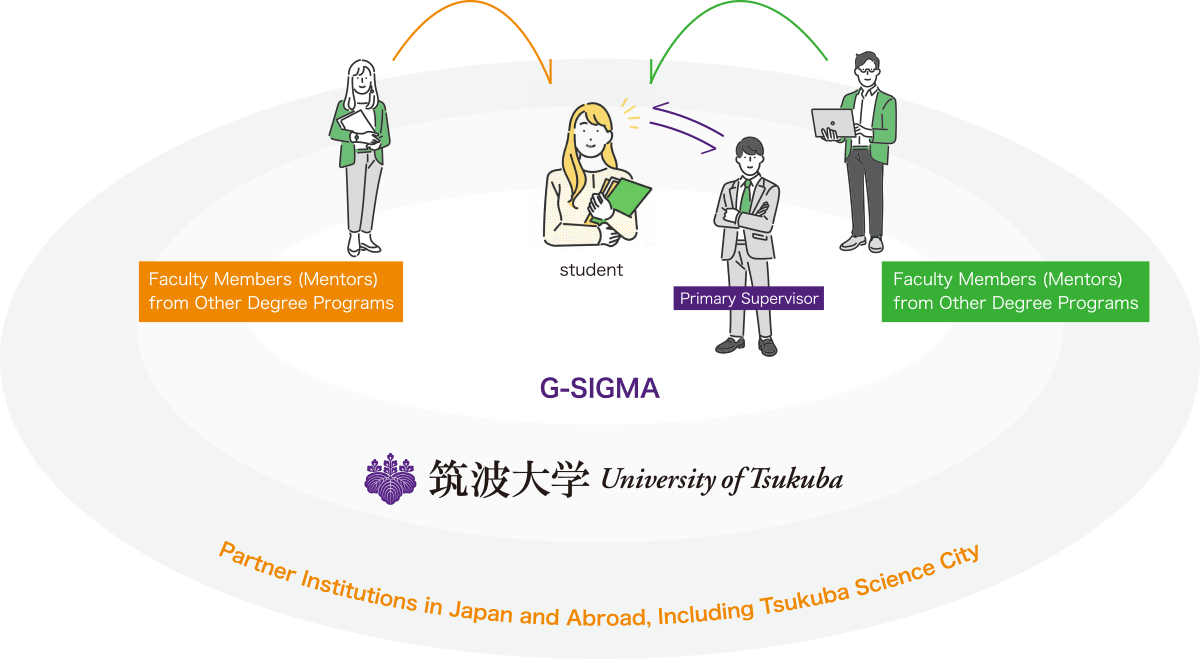
G-SIGMA adopts a multi-mentor system in which, in addition to a primary supervisor, multiple faculty members from different disciplines participate in research supervision. By reexamining research from diverse theoretical frameworks and methodologies, students are encouraged to reconstruct the research questions themselves and foster the emergence of new concepts.
Through the dynamic exchange of knowledge across disciplines, students can simultaneously achieve advanced specialization and interdisciplinary development.
Entrance and Tuition Fees
For detailed information regarding entrance and tuition fees, please see the following website:
https://www.tsukuba.ac.jp/en/admissions/fees-tuition/index.html
Entrance Fee Exemption and Tuition Waiver
Students who face financial difficulties and who demonstrate excellent academic records may be exempt from part or all of the tuition payments. For details, please see the following website:
https://www.tsukuba.ac.jp/en/admissions/financial-exemption/
Student Housing and Apartment Information
Student housing facilities are available on the Campus of the University of Tsukuba. In addition, apartments are widely available in the areas surrounding the university.
For further details, please visit the following website:
https://www.tsukuba.ac.jp/en/campuslife/support-healthlife/accommodation/
Scholarships and Financial Support
The ILS program does not offer its own scholarship schemes. However, students may apply for scholarships provided by the Japan Student Services Organization (JASSO) as well as those offered by various external organizations. For further details, please refer to the relevant information.br> https://www.tsukuba.ac.jp/en/admissions/financial-scholarships/
Teaching Assistant (TA)
Students in the Master's Program may work as Teaching Assistants (TAs) and provide educational support for undergraduate courses.
Students in the Doctoral Program may work as TAs and provide educational support for undergraduate and master's level courses.
Appointment as a TA is subject to a separate screening process.
For further details, please visit the following website:
https://www.tsukuba.ac.jp/en/campuslife/support-ta-handbook/
Research Assistant (RA)
Students in both the Master's and Doctoral Programs may be employed as Research Assistants (RAs) to support research activities. Appointment as an RA is subject to a separate screening process.
JSPS Research Fellowship for Young Scientists
Students enrolled in the Doctoral Program who are selected as JSPS Research Fellows will receive a monthly research stipend and will be allocated research funds per year.
For further details, please refer to the relevant information.
https://www.jsps.go.jp/english/e-pd/
Scholarship and Research Funding Information
By obtaining external research funding, students may conduct their research while covering expenses such as the purchase of books and costs associated with fieldwork. Some students acquire external funding to support and carry out their research during the process of writing their academic papers. Students are therefore encouraged to make use of the following University of Tsukuba information websites. (These websites are primarily available in Japanese, but English translations are also provided.)
Research Information Portal COTRE:https://ura.sec.tsukuba.ac.jp/
Research Funding Information Site (RISS) (for members of the University of Tsukuba only):https://www.research-fund.sec.tsukuba.ac.jp/
Career Support
The University of Tsukuba offers a wide range of programs and services to support students in their career development and employment activities. For further details, please visit the following website:
https://syushoku.sec.tsukuba.ac.jp/career/